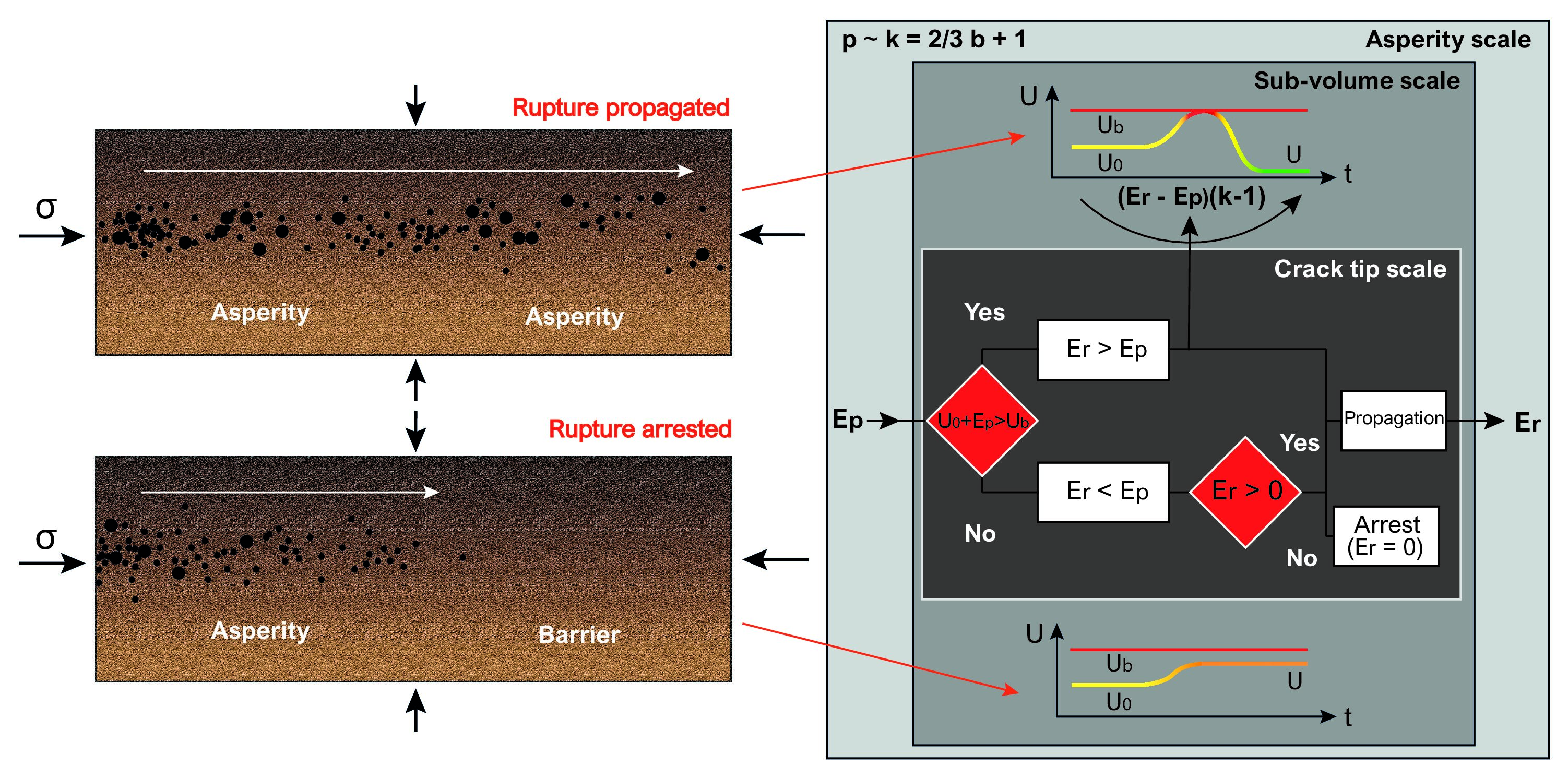
In this work, a model for describing the size-frequency scaling and the temporal evolution of seismicity is proposed starting from simple assumptions. The parameter describing how the number of earthquakes decreases after a major seismic event, p, turns out to be positively correlated to the exponent of the frequency-size distribution of seismicity, b, and related to tectonics.
Read full textTag: tectonics
Recent Posts
- Bayesian Estimation of Paleoearthquake Magnitudes in the Central Apennines
- Emergent Collective Dynamics in Fault Systems – Bridging Crustal Mechanics and Statistical Seismology
- Short-Sighted Faults: A New Model for Earthquake Recurrence and Crustal Memory
- Scale-dependent earthquake nucleation: Implications for seismicity,tectonics and laboratory experiments
- A statistical approach to foreshocks discrimination in Italy
Recent Comments
No comments to show.